

Hybrid teams typically need 60 to 80 square feet per employee, compared to the traditional 100 to 150 square feet per person, because most staff work from home several days per week and desk-sharing reduces space requirements.
The shift to hybrid working has fundamentally changed office space calculations. With employees spending 2 to 3 days per week in the office on average, businesses can reduce their property footprint whilst still providing excellent workspace.
How Do I Calculate Office Space Requirements for a Hybrid Team?
You calculate office space for a hybrid team by multiplying your headcount by your peak occupancy rate, then applying a space-per-person ratio based on your layout. For example, a 50-person team with 60% peak occupancy needs desks for 30 people.
Start by tracking actual office attendance over several weeks. Occupancy sensors or desk booking data make this easier than manual counts, and give you a clearer picture of office space utilisation before you commit to a lease. Most businesses find that peak occupancy sits between 50% and 70% of total headcount, typically on Tuesdays, Wednesdays, and Thursdays. Add a buffer of 10% to 20% above your typical peak to handle unusually busy days and accommodate growth.
Modern layouts with hot-desking or desk-sharing systems can reduce space requirements significantly. However, some employees may need dedicated desks due to their role or equipment needs.
See Also:
What Types of Office Space Do Hybrid Teams Need Most?
Hybrid teams need collaboration spaces, meeting rooms, and focus areas more than individual desks because people come to the office primarily for teamwork and meetings rather than solo work.
Meeting rooms become critical in hybrid offices. Plan for enough rooms to handle video calls, team collaboration sessions, and client meetings. A good rule is one meeting room for every 8 to 12 desks.
Collaboration zones with comfortable seating, whiteboards, and informal meeting areas encourage spontaneous conversations and teamwork. These spaces should make up 20% to 30% of your total footprint. Quiet focus areas or phone booths remain important for concentrated work and private calls.
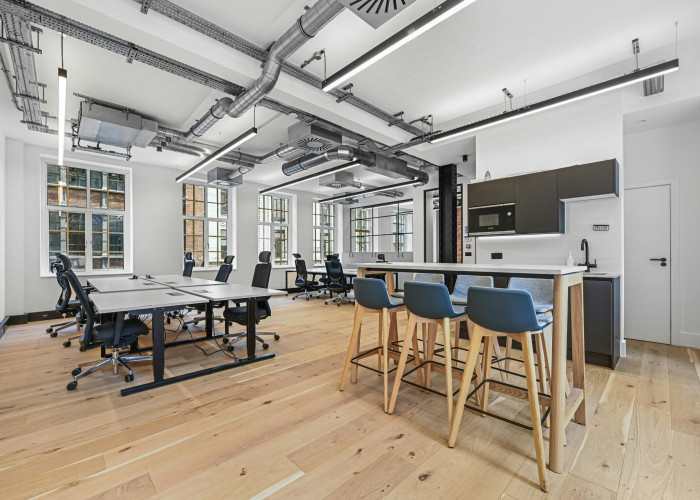
Should I Use Dedicated Desks or Hot-Desking for Hybrid Office Space?
You should move to hot-desking for most employees in a hybrid model, but maintain dedicated desks for roles requiring specialist equipment, daily office attendance, or specific accommodation needs.
Hot-desking typically achieves desk ratios of 0.6 to 0.8 desks per person, meaning significant space and cost savings. However, implementation requires proper booking systems, clear policies, and adequate storage solutions for personal items.
Senior staff, employees with multiple monitors or specialist equipment, and those with disabilities or health conditions that require specific workstation setups should generally retain dedicated desks.
How Much Meeting Room Space Do Hybrid Teams Need?
Hybrid teams need approximately 15% to 25% of total office space dedicated to meeting rooms, with a mix of sizes from small 2-person rooms for video calls up to larger 8 to 12-person boardrooms.
Small meeting rooms (2 to 4 people) should make up 40% to 50% of your meeting space. Medium rooms (6 to 8 people) work for team meetings and represent 30% to 40% of meeting space. Large boardrooms (10+ people) make up the remaining 10% to 20%.
Equip all rooms with quality video conferencing technology. Hybrid meetings with some attendees remote and others in-person are now the norm.
What Are the Cost Savings of Reducing Office Space for Hybrid Working?
The cost savings of reducing office space for hybrid working typically range from 20% to 40% of total occupancy costs when businesses reduce their footprint to match actual attendance patterns. For a central London office, this can mean savings of £50,000 to £150,000+ annually.
Rent represents the largest saving. Reducing from 100 to 70 square feet per employee in a prime London location at £70 per square foot saves £2,100 per person annually. For a 50-person team, that’s over £100,000 per year.
Service charges, business rates, utilities, and maintenance costs all decrease proportionally with reduced space. However, balance savings against employee experience—cramming too many people into insufficient space creates frustration and may drive staff turnover.
